
We are accustomed to hearing the older generations criticizing the younger ones, but it is worse than ever with Gen Z and Alpha upon us. It is easy to criticize someone or a group of people who are not like us whether it is age, race, religion, gender, career choice, education, perspectives, politics, and so on. It takes more effort to educate and understand the differences and then allow compassion and support to come forth. As I did research for accuracy of dates and timelines for this article, I discovered I am not the first to consider what I am about to lay out regarding mental health. This is comforting to the extent that other therapists have this in mind, but I feel much of the population does not. Therefore, I will be one more person attempting to summarize the big picture for anyone to read and digest so maybe more will offer support over criticism.
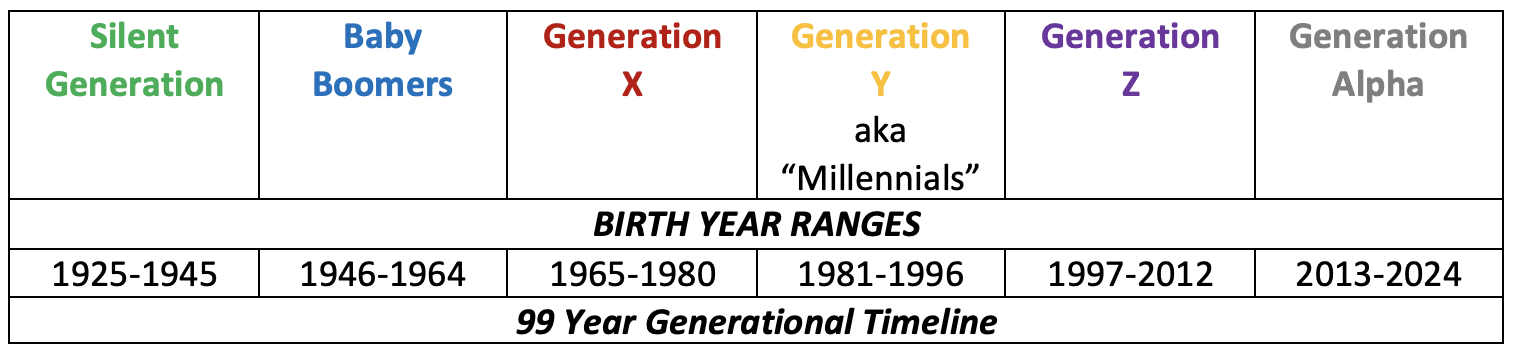
Let us review the generation groups in this article and really take in the total period of 1925-2024 which is only 99 years. It really isn’t that long of a period of time. Betty White passed just weeks before her 100th birthday on December 31, 2021. Clint Eastwood is 92 and still acting and directing movies. Jane Fonda is 85 and still acting. Lily Tomlin is 83 and still acting. Really think about what 99 years really is.
Let’s begin with the Silent Generation who lived through the Great Depression (1929-1939). Women are fighting for rights to be considered equals to men and a lack mindset is setting in as the trauma of financial and security loss falls upon most Americans. They line up for free bread and rations, store food because you never know, suicides spike, and most “suck it up” and do what is necessary to survive. Movie theaters and radio along with printed newspaper is how you understood what was happening in the world. Using your creativity, being outside, socializing face to face, writing letters, and speaking on the corded telephone was how you lived socially and listened to music on vinyl records. The LGBTQ community existed but in secret and more underground as this was considered illegal and deviant, even though it was widely accepted and not thought of twice as far back as ancient texts and art indicate. Racism and segregation is commonplace with violence against anyone not a white straight man being overlooked. Their trauma is to not show weakness through emotion, to work hard and not complain, to hoard resources, to hide their authenticity, most subscribe to an organized religion, and they know security is not a guarantee. This generation was about “working within the system.” They did this by keeping their heads down and working hard, thus earning themselves the “silent” label. Their attitudes leaned toward not being risk-takers and playing it safe.
This generation is now giving birth to and raising children of the “Baby Boomers” generation (1946-1964) and passing on this mindset of lack. Although this generation experienced some of the best financial abundance, hence the baby boom, women were still considered less than but steadily making progress, segregation is alive (did not end until 1964), racism was in your face, LGBTQ relationships are still dangerous but more open, interracial marriages were illegal (fully legal in US in 1967), and war was still a dark reality as the draft took young men to battle to either give their lives or come home with severe PTSD. Everyone is fighting for freedom in all spaces with protests being an everyday event and radical groups being established. Meditation and yoga come into more mainstream but is viewed as a “hippie” activity which is seen as weak while more conservative religious groups begin to rise. Mental wellness is not a widely accepted concern and seeking help from a therapist came with an attached stigma and yet showing emotions or expressing difficulties is weakness. Compounded trauma of being hardened, feeling you need to constantly fight for rights of being a human being, holding back your authentic self, security is never guaranteed, and consumerism is on the rise. Added to the mix is the new media of television being introduced which allows you to see, not just hear, what is happening around the country and the world. Marketing and propaganda begin to leverage this media and capitalism flourishes. Televisions progress quickly from small black and white consoles to full color box televisions. People still had face to face interactions but spent a little less time outside because of what television had to offer. They listened to music on vinyl records and 8-track tapes, began eating more fast food thanks to marketing and life becoming more fast paced, and began seeing a rise in conditions like anxiety and depression which medical doctors would prescribe drugs for.
“Generation X” is now upon us as they are born between 1965 and 1980. Computers are being used but do not make their way into households until 1977 and became more common in early 1980’s. Music media moves quickly to cassette tapes and then CD’s, both allowing music to be taken with you easily via a Walkman. Television now offers Music Television (MTV) and Home Box Office (HoBO… now HBO) to see movies in home that used to require getting out to a theater and late night television is in full swing. Video games from Atari systems to handhelds are in homes and begin to evolve quickly. This generation grew up with more latch key kids, stuck in their homes, using their imagination, watching television, reading, taking in the outdoors as much as they could when possible, being told to be quiet, be tough, and work hard. More two parent income households as the economy began to take a downturn, these parents with so much compounded trauma began creating more for this generation in setting the bar at more is better and what you have is never enough. Perfection was key to being successful and so the pressure was on for better grades, selecting a profession that made you a lot of money or provided stability and great pension at the end of it all, and some put the pressure on their religion of choice. Disregard for talent, passion, and creativity because this did not make you money and give you value, and those who chose that were less than, weaker, and not as valuable. Religious trauma is on the rise, women are still fighting for autonomy, racism simmered below the surface more, but now the LGBTQ community is starting to test the waters of being more widely accepted. In 1974, The Equal Credit Opportunity Act was passed, and women were able to apply for credit cards in their own name, regardless of marital status, but as young girls are being raised in a household filled with trauma, they learn to not count on anyone but themselves. Hyper-Independent women are being raised, violence against LGBTQ is publicized more, mental health is becoming more critical but yet still stigmatized. Life is becoming more fast paced as the pressure to do more with less continues to increase.
Generation X now gives life to “Generation Y”, also known as the Millennial Generation, from 1981-1996 and decide they will raise their children differently as they realize all the trauma they grew up with. They want their children to express themselves, embrace their emotions, be more open and creative, show more acceptance, and be successful. However, due to the financial downturn, the lack of jobs, and more people going to college, some Gen X wait until later in life to have children and they give birth to Generation Z (1997-2012), which is an entirely new awakening. But let’s talk about the Millennials here for a moment to understand this specific group. Computers are in many homes, basic cell phones are coming about, music is MP3 and you have iPODs, television has full cable with hundreds of channels, MySpace social platform starts up in 2003, the environment is becoming a bigger concern as it deteriorates due to lack of attention. Online gaming, streaming music services, and still a sense of lack existing as people become more connected to where they are constantly bombarded with marketing, political agendas, propaganda, and bullying. The LGBTQ community is becoming more present and accepted, being authentic is encouraged and yet criticized, mental health is declining even more but acceptance of therapy is on the rise. Religious zealots are coming into the media more, the bleak future of the economy and environment, and the pressure to go to college although there are not enough jobs is overwhelming. This generation decides to do what they want and stay with parents longer than the generations prior. The compounded trauma sends many of this generation into a limbo where they struggle with purpose, an unacceptable definition of success, and an overall disgust with the state of society.
A blend of Gen-X and Gen-Y are giving life to Generation Z (1997-2012) who are the game changers. This generation is receiving years of compounded trauma via their parents but with a significant twist. They see what a chaotic mess the world is with no filter. They challenge trauma-based mindsets, embrace their authenticity, desire LGBTQ to be fluid and fully accepted, embrace mental health, do not prioritize working your life away over living it, and fights hard against inequality. Smartphones take being connected to a whole new level, they are constantly texting, browsing and posting on various social media platforms, utilize television as a constant background, online gaming, and more. Constantly connected and over-stimulated, the cases of ADD/ADHD skyrocket and the pressure from their traumatized parents is overwhelming. What they are being pressured to do by parents and/or society counterintuitive, they feel it in their gut, they see it in their awareness. Bullying is rampant because it now does not need to be done face to face, it can be done via text, direct messaging on social media, public social media shaming. Depression, anxiety, and suicide is the highest it has ever been, and anti-depressants/anti-anxiety medications are making big pharma grossly rich. Trying to numb children with ADD/ADHD medications to make them compliant while they just try to be accepted because the older generations do not have time to stop and consider their feelings. The older generations are just trying to work faster, harder, longer, and acquire more. Gen-Z cannot understand what they are seeing and are frustrated, sick and tired of being told they do not understand life because they are young, tired of seeing capitalism disregard humanity, tired of being told that is just how life is, angry when witnessing racism raise its ugly head from the weeds it sat in for so long, disgusted by all the generations before them still around pushing against change and yet touting change is good in capitalist corporations. They have trauma of lack mindset and yet are pressured to acquire while religion, especially Christianity segments, is trying hard to maintain control. The reality of the price of homes and even rent is out of reach for the majority of this generation and would require multiple incomes in a home, but the older generation say they just need to work harder. The hyper-independence and trauma are crushing as misogyny is still out there and now more social on platforms. They are activists who feel like they tread water and are angry that people are so attached to their egoic identity that they cannot just stop and see what is really happening. And now Generation Alpha is being born (2013-2024) by Gen-Y and some young Gen-Z. However, many Gen-Z are saying they do not want children because they are already angry for being brought into this world of suffering and many are unsubscribing from a religion. We see their impact on elections and the older generations on the conservative side panic and want to limit the power they are starting to wield with talks of raising voting age. The change is coming and no matter how hard you try to delay it, it will happen.
Take a step back now and look at all that has occurred in such a short period of time. We criticize Gen Z for not wanting to have children, for more of them not wanting to subscribe to a religion, for not wanting to subscribe to the institution of marriage, for women wanting to buy their own homes and live as single and possibly have a child on their own, for putting mental health in our faces, for fighting for humanity and authenticity, for being more gender and sexually fluid, and for wanting to live their lives truly free. If you open your mind and your eyes to really take all of this in, you should feel deep overwhelming compassion for this generation and a sadness for the trajectory of our civilization as we are all guilty for allowing the train to just keep moving faster while sacrificing life. Instead of criticizing and trying to hold onto your comfortable trauma, your ego, embrace this generation and support them, because they can change the world for the better and help save it. Haven’t we always said we want a better life for our children? Do we really mean it? The saying evolve or parish is fitting for this situation and I am hopeful that the awakening of Gen-Z and Alpha will be an amazing revolution.